Growth
Two chickens, two cows, a few rabbits: animals that breed grow faster and faster. If your farm doubles every day, how many animals do you have after a week? How many days until there are 1000? And how many digits does that number have, so it fits on the display? EXP and LOG answer all three.
Functions: EXP and LOG, with ROUND and INT
What you need
A trigger block with a button and a display block. The functions have default values, so they run without items. To change them: the variable items start, days, goal and number of type INTEGER and factor of type FLOAT, and one uninitialized item for the result.
The idea
A farm that starts with start animals and grows by the factor every day has start × factor^days animals after days days. Doubling means the factor 2: 1, 2, 4, 8 … 128 after a week.
EXP and LOG are the two halves of this power:
- LOG, the natural logarithm, turns multiplying into adding: LOG(2) is the growth of one day, and
days × LOG(2)the growth of all days together. - EXP turns that sum back into a factor:
factor^daysisEXP(days × LOG(factor)). This is how the computer calculates powers anyway.
The real use of LOG is the question backwards: how many days until the farm has goal animals? The farm must grow by goal / start, and each day adds LOG(factor) of growth, so it takes LOG(goal / start) / LOG(factor) days. With the same trick, LOG counts the digits of a number: a number with 4 digits is at least 10³ and below 10⁴, so LOG(number) / LOG(10) is between 3 and 4.
The program
PROGRAM farm
NOOP
INCLUDE c0de/math
NOOP
FUNCTION grow
    PARAMETER start INTEGER 1
    PARAMETER factor FLOAT 2.0
    PARAMETER days INTEGER 7
    RESULT count INTEGER
BEGIN
    VARIABLE rate FLOAT
    VARIABLE growth FLOAT
    CALL c0de/math/LOG
        PARAMETER value factor ;
        RESULT result rate
    CALL CLS
    FOR day INTEGER 0 ; days ;
    BEGIN
        CALL c0de/math/EXP
            PARAMETER value day * rate ;
            RESULT result growth
        CALL c0de/math/ROUND
            PARAMETER value start * growth ;
            RESULT result count
        CALL PRINT
            PARAMETER value "Day " ⊕ day ⊕ ": " ⊕ count ;
    END FOR
END FUNCTION
NOOP
FUNCTION daysUntil
    PARAMETER start INTEGER 1
    PARAMETER factor FLOAT 2.0
    PARAMETER goal INTEGER 1000
    RESULT days INTEGER
BEGIN
    VARIABLE ratio FLOAT
    VARIABLE rate FLOAT
    IF goal ≤ start ;
    BEGIN
        RETURN
    END IF
    CALL c0de/math/LOG
        PARAMETER value goal / start ;
        RESULT result ratio
    CALL c0de/math/LOG
        PARAMETER value factor ;
        RESULT result rate
    CALL c0de/math/INT
        PARAMETER value 0 - ratio / rate ;
        RESULT result days
    ASSIGN days 0 - days ;
    IF start * factor ^ ( days - 1 ) ≥ goal ;
    BEGIN
        ASSIGN days days - 1 ;
    END IF
END FUNCTION
NOOP
FUNCTION digits
    PARAMETER number INTEGER
    RESULT digits INTEGER
BEGIN
    VARIABLE logarithm FLOAT
    VARIABLE ten FLOAT
    CALL c0de/math/LOG
        PARAMETER value number ;
        RESULT result logarithm
    CALL c0de/math/LOG
        PARAMETER value 10 ;
        RESULT result ten
    CALL c0de/math/INT
        PARAMETER value logarithm / ten ;
        RESULT result digits
    ASSIGN digits digits + 1 ;
    IF 10 ^ digits ≤ number ;
    BEGIN
        ASSIGN digits digits + 1 ;
    END IF
END FUNCTION
Building and running it
Bind the display block to the program farm and the function you want, and set the trigger block to the same function.
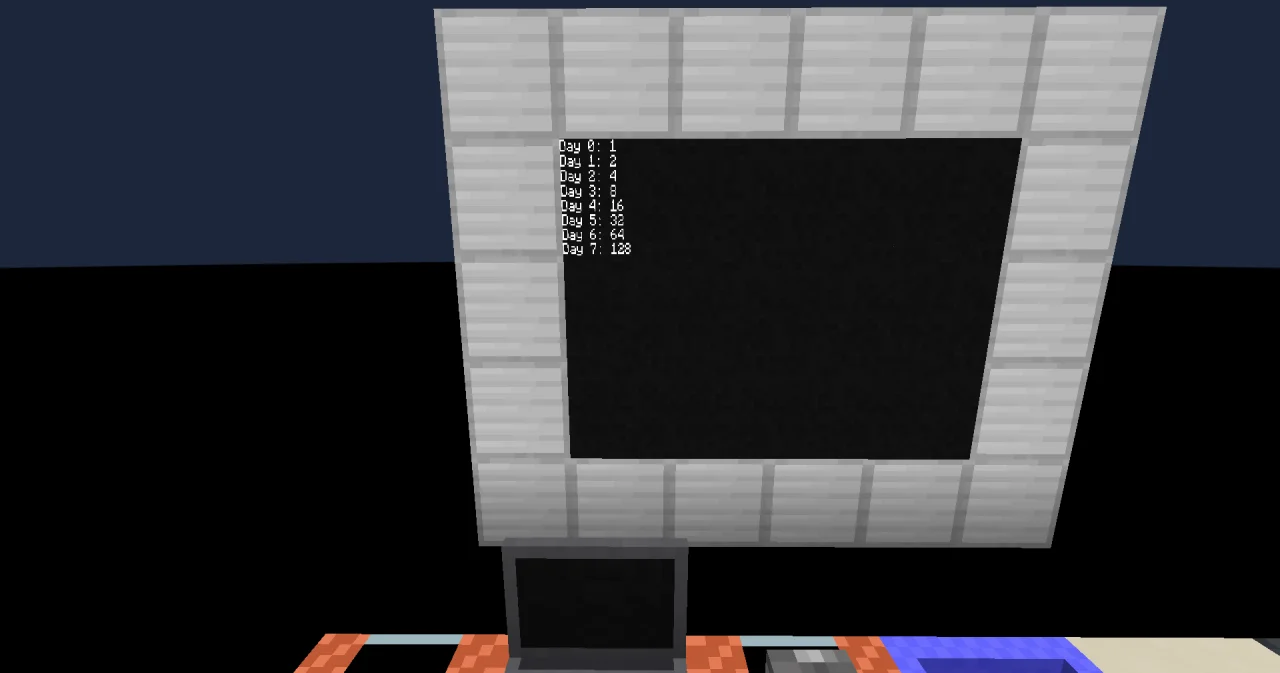
growwithout items: the display showsDay 0: 1toDay 7: 128, andcountis 128.daysUntilwithout items:daysis 10. After 9 days the farm has 512 animals, after 10 it has 1024, the first number of at least 1000.digitswithnumber= 1000: 4. With 999 it is 3.
How it works
- LOG once, EXP every day.
rateis LOG(factor), computed before the loop. Each day, EXP ofday * rategives the growth since day 0. EXP returns a FLOAT like 127.99999999999997, so ROUND makes whole animals of it. With the operator^,start * factor ^ daywould give the same numbers. - Rounding up with INT. 9.97 days must become 10 days: the farm reaches 1000 only on day 10. INT rounds down, so the program rounds
-9.97down to -10 and turns the sign back: that is rounding up. - The check after LOG. A FLOAT is often a tiny bit off. LOG(1000) / LOG(10) gives 2.9999999999999996 instead of 3, and INT turns that into 2: without the check,
digitswould say 1000 has 3 digits. The IF compares with the exact INTEGER power10 ^ digitsand corrects it.daysUntilchecks the same way whether one day less is already enough. - What LOG can't do. LOG only takes numbers greater than 0:
digitswith 0 crashes with INVALID_ARGUMENT. A factor of 1 doesn't grow at all; its LOG is 0, anddaysUntilwould divide by 0. Agoalthe farm has already reached gives 0 days without any LOG.
Try it yourself
- A rabbit farm with 10 rabbits grows by half every day (factor 1.5). On which day does it pass 100 rabbits?
Solution
No new program: run daysUntil with start = 10, factor = 1.5 and goal = 100. days is 6: 10 × 1.5⁵ is about 76, 10 × 1.5⁶ about 114. grow with the same start and factor and days = 6 shows the rabbits day by day.
- Remove the IF from
digitsand try the numbers 99, 100, 999 and 1000. Which answers are wrong?
Solution
99 and 999 still give 2 and 3, and 100 gives 3, because LOG(100) / LOG(10) happens to be exactly 2.0. 1000 gives 3 instead of 4: LOG(1000) / LOG(10) is 2.9999999999999996. Whether a FLOAT is a tiny bit off can't be seen in advance, so a calculation with LOG that must give an exact whole number needs a check with whole numbers.