Rolling dice
A die for every game: a D6 for board games, a D20 for adventures, three of them at once, with the numbers and their total on a display. With a seed, the die rolls the same numbers on every run – handy for testing, and for a game that everybody should play with the same luck.
Functions: RANDOM, RANDOMIZE, INT and FIX
What you need
A trigger block with a button, a display block (16 columns and 8 rows are enough) and an uninitialized variable item for the result total. If you like, the variable items sides, count and seed of type INTEGER; without them, the die is a single D6. For "INT or FIX?": two uninitialized items for the trigger block.
The idea
RANDOM gives a FLOAT from 0 up to below 1. A die needs a whole number from 1 to sides, each equally likely. Multiply by sides, and the number is from 0 up to below sides; add 1, and it is from 1 up to below sides + 1. INT cuts it down to the whole number below: for a D6, everything from 1.0 to 1.999… becomes 1, everything from 6.0 to 6.999… becomes 6. Each of the six numbers gets a slice of the same width, so each is equally likely.
The numbers of RANDOM aren't really random: they are computed one after the other from a start value, the seed. Each process gets its own generator with its own seed, so every run is different. RANDOMIZE sets the seed yourself, and from then on the process rolls the same sequence every time.
The program
PROGRAM anydie
NOOP
INCLUDE c0de/math
NOOP
FUNCTION roll
    PARAMETER sides INTEGER 6
    PARAMETER count INTEGER 1
    PARAMETER seed INTEGER 0
    RESULT total INTEGER
BEGIN
    VARIABLE chance FLOAT
    VARIABLE die INTEGER
    IF seed ≠ 0 ;
    BEGIN
        CALL c0de/math/RANDOMIZE
            PARAMETER seed seed ;
    END IF
    CALL CLS
    FOR i INTEGER 1 ; count ;
    BEGIN
        CALL c0de/math/RANDOM
            RESULT result chance
        CALL c0de/math/INT
            PARAMETER value chance * sides + 1 ;
            RESULT result die
        CALL PRINT
            PARAMETER value "D" ⊕ sides ⊕ ": " ⊕ die ;
        ASSIGN total total + die ;
    END FOR
    CALL PRINT
        PARAMETER value "Total: " ⊕ total ;
END FUNCTION
Building and running it
- Place the display block, right-click it, click the buttons until they show
anydieandroll, and click ✔. - Set the trigger block to the program
anydieand the functionroll. Put an uninitialized variable item into its input inventory fortotal. - Press the button. The display shows something like
D6: 4andTotal: 4; press again for a new number. - Now add the items
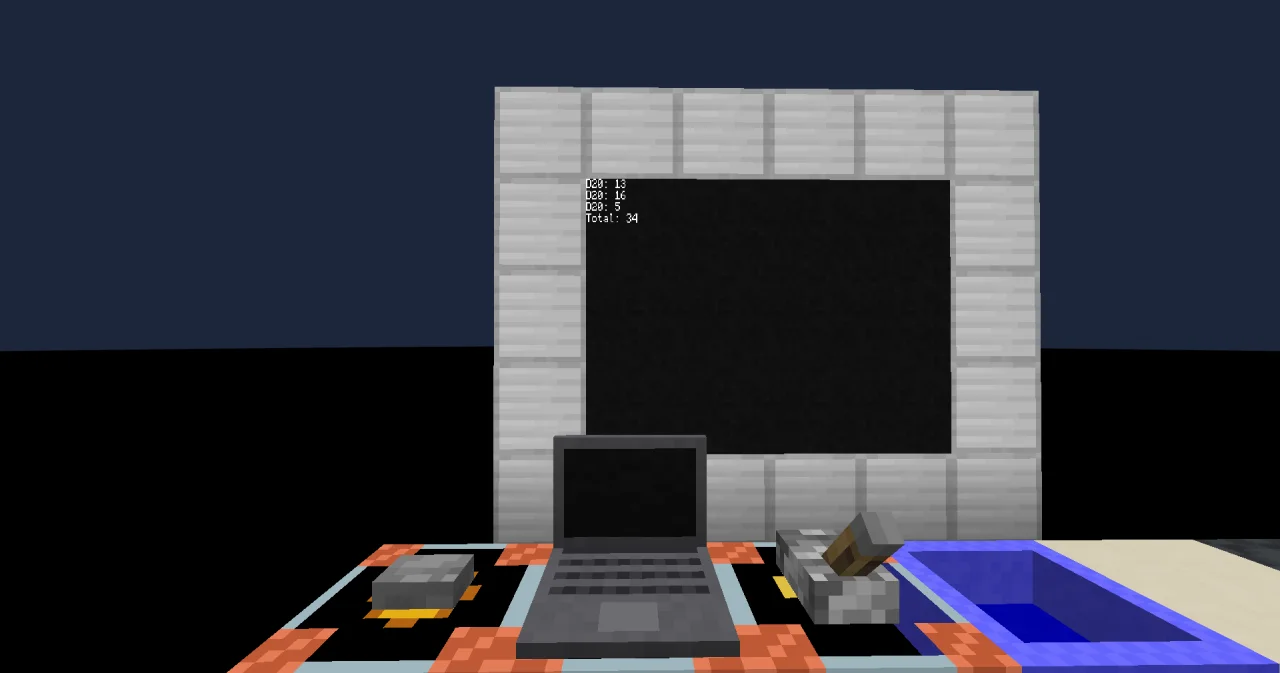
sides= 20,count= 3 andseed= 42 and press the button. The display shows:
D20: 15
D20: 4
D20: 6
Total: 25
Run it again with the same three items: the same three numbers. That is what the test of this program checks, too. Leave out the item seed, and the die is random again.
How it works
- Defaults instead of items.
sides,countandseedhave default values, so the trigger block starts without their items. A parameter item, if there is one, overrides the default. - In this program, seed 0 means "really random". RANDOMIZE only runs if
seedisn't 0. The seed only affects the current process, so it doesn't change the dice of other programs or of the next run without the item. chance * sides + 1goes into INT directly: a PARAMETER line takes any expression. The resultdieis an INTEGER, ready for the text.- Why INT and not ROUND? ROUND would turn 0.0 to 0.499… into 0 – a seventh number, and 1 and 6 would get only half a slice each. INT gives every number a full slice.
INT or FIX?
Both turn a FLOAT into an INTEGER. INT rounds down, FIX cuts off the decimals. For positive numbers that's the same, so the die could use either. They differ below 0: INT turns -0.5 into -1, FIX into 0.
That matters for a random step to the left, nowhere or to the right, -1, 0 or 1: chance * 3 - 1 is from -1 up to below 2. This program rolls it 120 times and counts how often each step comes up, once with INT and once with FIX:
PROGRAM randomsteps
NOOP
INCLUDE c0de/math
NOOP
FUNCTION compare
    PARAMETER rolls INTEGER 120
    PARAMETER seed INTEGER 42
    RESULT withInt ARRAY INTEGER
    RESULT withFix ARRAY INTEGER
BEGIN
    VARIABLE chance FLOAT
    VARIABLE step INTEGER
    VARIABLE slot INTEGER
    FOR i INTEGER 0 ; 2 ;
    BEGIN
        ASSIGN withInt[i] 0 ;
        ASSIGN withFix[i] 0 ;
    END FOR
    CALL c0de/math/RANDOMIZE
        PARAMETER seed seed ;
    FOR i INTEGER 1 ; rolls ;
    BEGIN
        CALL c0de/math/RANDOM
            RESULT result chance
        CALL c0de/math/INT
            PARAMETER value chance * 3 - 1 ;
            RESULT result step
        ASSIGN slot step + 1 ;
        ASSIGN withInt[slot] withInt[slot] + 1 ;
        CALL c0de/math/FIX
            PARAMETER value chance * 3 - 1 ;
            RESULT result step
        ASSIGN slot step + 1 ;
        ASSIGN withFix[slot] withFix[slot] + 1 ;
    END FOR
END FUNCTION
Use the same trigger block: take the items of the die out, set it to randomsteps and compare, and put two uninitialized items into it for the results withInt and withFix. The program prints nothing, so the display stays as it is; the 120 rolls take the cursor about a minute. With the seed 42, withInt is [46, 27, 47] and withFix is [0, 73, 47]. With INT, all three steps come up about equally often. FIX turns everything from -1 up to 0 into 0, so -1 never comes up and 0 is twice as likely. Use INT for random numbers that can be negative; FIX is for cutting off decimals, like a price without its cents.
Try it yourself
- A treasure chest picks one reward from a list: diamond, emerald, gold ingot, iron ingot or bread. Show it on the display.
Solution
The same trick with the length of the list instead of sides, and without the + 1, because indexes start at 0: INT turns chance * count into 0 to count - 1.
PROGRAM reward
NOOP
INCLUDE c0de/math
VARIABLE prizes ARRAY STRING
BEGIN
    "diamond" "emerald" "gold_ingot" "iron_ingot" "bread"
END VARIABLE
NOOP
FUNCTION pick
    PARAMETER seed INTEGER 0
    RESULT prize STRING
BEGIN
    VARIABLE chance FLOAT
    VARIABLE count INTEGER
    VARIABLE index INTEGER
    IF seed ≠ 0 ;
    BEGIN
        CALL c0de/math/RANDOMIZE
            PARAMETER seed seed ;
    END IF
    CALL LEN
        PARAMETER value prizes ;
        RESULT result count
    CALL c0de/math/RANDOM
        RESULT result chance
    CALL c0de/math/INT
        PARAMETER value chance * count ;
        RESULT result index
    ASSIGN prize prizes[index] ;
    CALL PRINT
        PARAMETER value "You win: " ⊕ prize ;
END FUNCTION
With the item seed = 42, the reward is always iron_ingot.
- Why does the program roll the same numbers after
RANDOMIZEwith 42 although every process has its own random number generator?
Solution
Every generator computes its numbers the same way; only the start value differs. RANDOMIZE sets the start value, so two processes with the same seed compute the same sequence: the first RANDOM gives the same FLOAT, so the first die is the same, and so on. A different seed, like 7, gives a different sequence – again the same on every run.
Read more
- The handbook pages of RANDOM, RANDOMIZE, INT and FIX, and all of c0de/math
- Rounding in the guide
- Display block and PRINT
- Using libraries: the first die, in the path "Learning to program"